Our History
Discover the story of Bethlehem Lutheran Church.
The Story of Bethlehem
Bethlehem Lutheran Church, located in West Dundee, Illinois, has been serving the community and sharing God’s word for more than 110 years. This is the story of the people who founded the church, nurtured and grew it, financed it, donated countless gifts to its buildings, and worked tirelessly to maintain and improve it over the past century and beyond. While this brief history cannot include the many names of those who contributed their time, talents, and resources, their impact is felt in every corner of our church. Time and again, they stepped out in faith to accomplish things they were not fully prepared for, trusting that God would bless their endeavors.
Early Days
In 1909, a group came together to establish a Lutheran church in West Dundee. They were led by John F. Fierke, the owner of the Illinois Iron and Bolt Company. The church was officially organized as the Evangelical Lutheran Bethlehem Kirche on December 5, 1909. The congregation was formally incorporated in Kane County on May 1, 1910. At its inception, the church had 42 voting members (men) and 178 additional members (women and children).
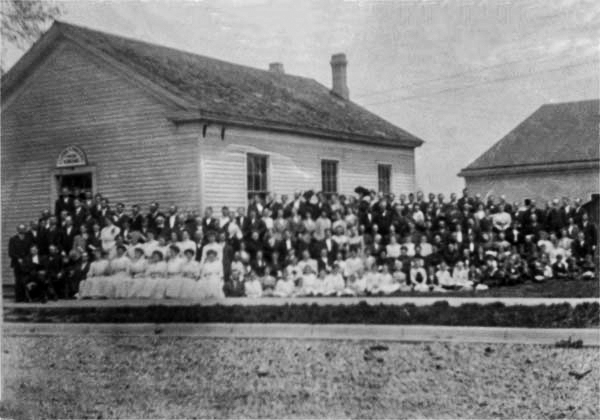
The original church with the congregation, 1911.
A one-story wooden building located at 111 North Fourth Street was selected as the church. Originally built in 1844 by the Congregationalists, it was later used by the Scotch Presbyterians, the Zion German Methodists, and finally Bethlehem Lutheran. The congregation purchased the property for $1,100.
Originally, Bethlehem was a German-speaking church. Sermons and classes were conducted in German, and its books and records were maintained in German.
Establishing Bethlehem at Fourth and Main
It was eventually decided to acquire a lot at Fourth and Main as the ideal location for building a permanent church. Bethlehem purchased the lot, along with the house on it, for $4,300. The house was moved to the back of the property, turned to face Fourth Street, and served as the parsonage until a new one was constructed in 1953. The new church building was completed on January 28, 1912. The donated bell, along with the hammer and clamps, weighed a total of 5,950 pounds and cost $2,000. The bell was tuned to harmonize with the other bells in town. Additionally, a donated state-of-the-art Estey organ was installed.
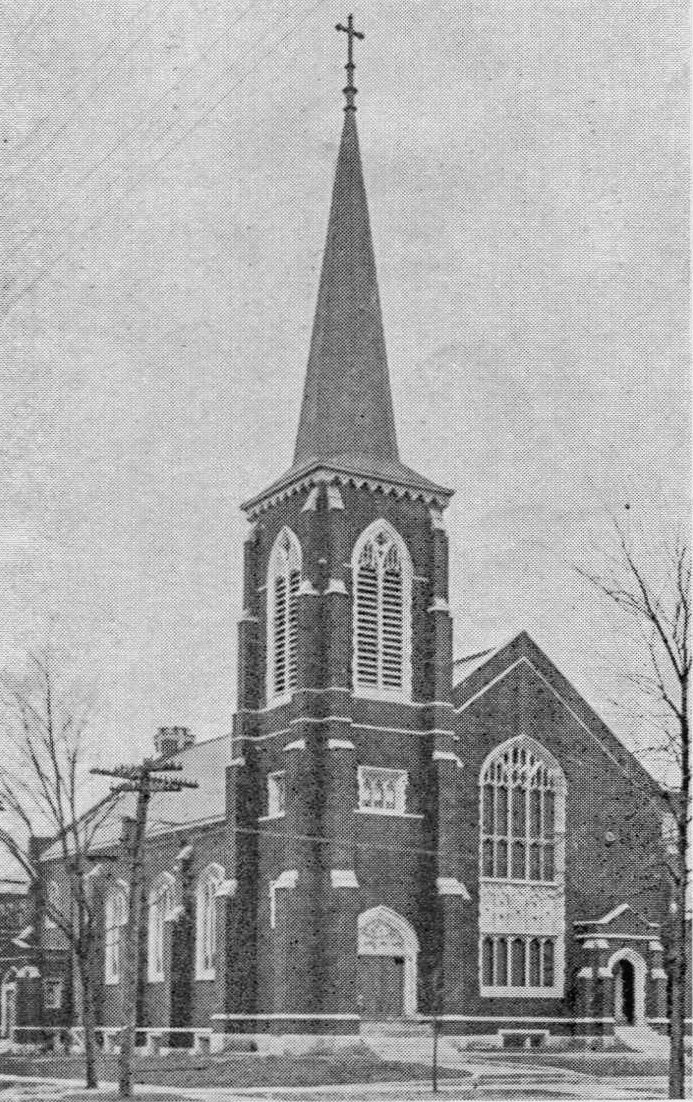
The new church, 1912.
Typical Sunday offerings from the congregation around this time ranged from $7.76 to something over $20. Originally Bethlehem was a German-speaking church. Sermons and classes were presented in German, and its books and records were kept in German.
People had to register before communion, forming a line at the pastor’s office to announce their intentions. Men and women went to communion separately. Over time, registration practices began to decline, and men and women started receiving communion together in what became known as Mixed Communion.
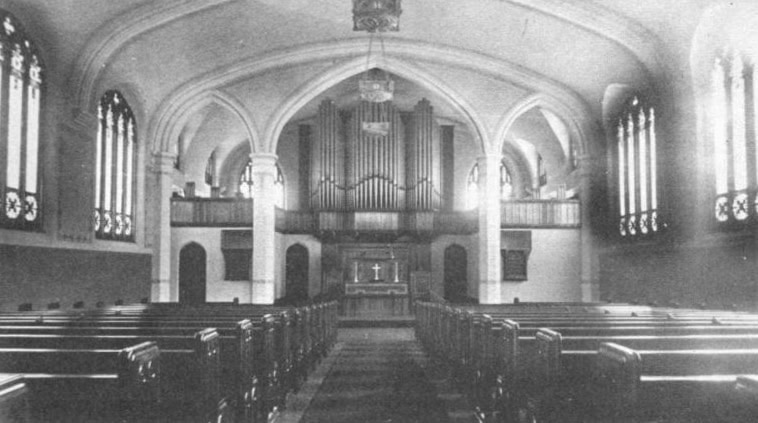
The new church interior, 1911.
Bethlehem's Growth and Transition
As the German language became less prevalent, some worship services and classes gradually began to be held in both English and German, and eventually, only in English. In 1933, the church’s books and records were switched to English.
Bethlehem also operated a day school in its early years, which was held in the one-story wooden building that had served as the first church. The man responsible for starting the furnace at the school each morning was paid $2 a month. By 1928, the congregation decided it was unwilling to bear the costs of necessary repairs to the building. As a result, Bethlehem agreed to send its students to Immanuel Lutheran. By 1980, forty-five to fifty Bethlehem students were enrolled at Immanuel Day School, which offered a friendly tuition rate. During school days, Immanuel also used Bethlehem’s choir room to teach approximately 70 nursery school children.
In 1937, the Ladies’ Aid Society, with a membership of about thirty women, was actively involved in all aspects of church life. The society was divided into committees and managed its finances with great care. The women organized lunches, dinners, and parties, frequently loaned money to the congregation, and handled various practical needs, such as paying the gas bill, maintaining the kitchen, and purchasing new dishes. They also sent cards and visited ill members, sent cards and flowers for special anniversaries, and supported the orphan home in Addison with donations of food and clothing.
In the early 1950s, a new parsonage was built on the site of the original church. During the late 1950s, the church interior was completely modernized and redecorated in preparation for Bethlehem’s Golden Anniversary. Many families generously donated items for the renovation. The Rededication Service was held on February 2, 1958. This allowed the congregation to celebrate its fiftieth anniversary in a beautifully updated building, ready to serve the community for another fifty years.
Bethlehem also operated a day school in its early years, which was held in the one-story wooden building that had served as the first church. The man responsible for starting the furnace at the school each morning was paid $2 a month. By 1928, the congregation decided it was unwilling to bear the costs of necessary repairs to the building. As a result, Bethlehem agreed to send its students to Immanuel Lutheran. By 1980, forty-five to fifty Bethlehem students were enrolled at Immanuel Day School, which offered a friendly tuition rate. During school days, Immanuel also used Bethlehem’s choir room to teach approximately 70 nursery school children.
In 1937, the Ladies’ Aid Society, with a membership of about thirty women, was actively involved in all aspects of church life. The society was divided into committees and managed its finances with great care. The women organized lunches, dinners, and parties, frequently loaned money to the congregation, and handled various practical needs, such as paying the gas bill, maintaining the kitchen, and purchasing new dishes. They also sent cards and visited ill members, sent cards and flowers for special anniversaries, and supported the orphan home in Addison with donations of food and clothing.
In the early 1950s, a new parsonage was built on the site of the original church. During the late 1950s, the church interior was completely modernized and redecorated in preparation for Bethlehem’s Golden Anniversary. Many families generously donated items for the renovation. The Rededication Service was held on February 2, 1958. This allowed the congregation to celebrate its fiftieth anniversary in a beautifully updated building, ready to serve the community for another fifty years.

The new church interior, 1958.
In 1962, Bethlehem received a gift that earned it the nickname “Church of the Lighted Cross.”
Sunday School classes were held in the Fellowship Hall, with chalkboards used as dividers, as well as in the upper balconies and any other available space. Discussions began about constructing an education addition to the church. Eventually, the land south of the church was purchased, and the old parsonage was moved to Lincoln Avenue. Groundbreaking for an education building, designed to harmonize with the church, took place on June 21, 1964. The building was completed in time for its dedication on May 2, 1965.
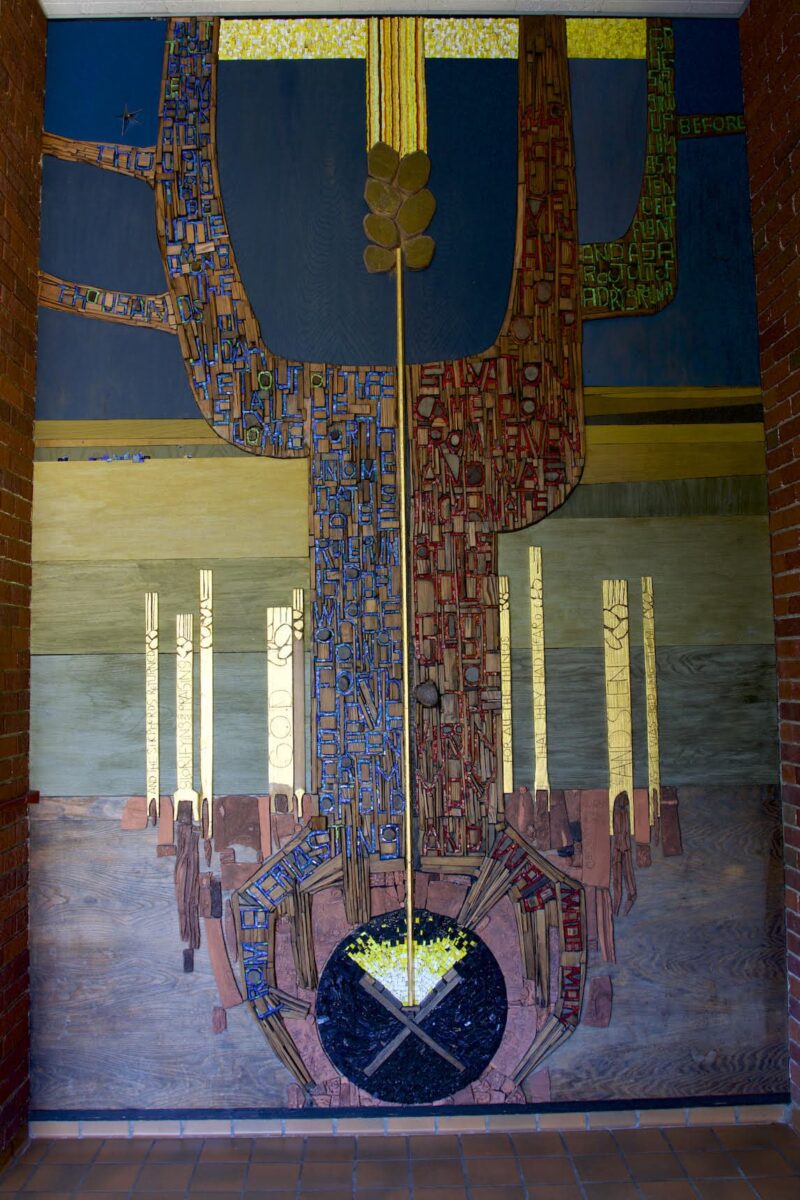
A beautiful feature of the new building was a donated mural at the Fourth Street entrance, created by artist Reinhold Marxhausen. The mural depicts two main ideas: grainfields, symbolizing the meaning of the word “Bethlehem,” and trees, which reference both the Garden of Eden and the tree on which Christ gave His life. For those interested in learning more, a detailed description of the mural’s meaning is provided on a plaque next to the artwork.
Sunday School classes were held in the Fellowship Hall, with chalkboards used as dividers, as well as in the upper balconies and any other available space. Discussions began about constructing an education addition to the church. Eventually, the land south of the church was purchased, and the old parsonage was moved to Lincoln Avenue. Groundbreaking for an education building, designed to harmonize with the church, took place on June 21, 1964. The building was completed in time for its dedication on May 2, 1965.
A beautiful feature of the new building was a donated mural at the Fourth Street entrance, created by artist Reinhold Marxhausen. The mural depicts two main ideas: grainfields, symbolizing the meaning of the word “Bethlehem,” and trees, which reference both the Garden of Eden and the tree on which Christ gave His life. For those interested in learning more, a detailed description of the mural’s meaning is provided on a plaque next to the artwork.
From the 1980s through the 1990s
The church added its first additional staff member in its history—a Director of Christian Outreach. By the 60th anniversary, more than 500 members were worshipping at Bethlehem.
In preparation for the 75th anniversary in 1984, the church was redecorated once again.
During the 1980s and 1990s, the evangelism committee expanded from five to twenty members, and the church welcomed 100 to 125 new members each year. By 1997, the congregation had grown to 1,420 baptized members.
In preparation for the 75th anniversary in 1984, the church was redecorated once again.
During the 1980s and 1990s, the evangelism committee expanded from five to twenty members, and the church welcomed 100 to 125 new members each year. By 1997, the congregation had grown to 1,420 baptized members.
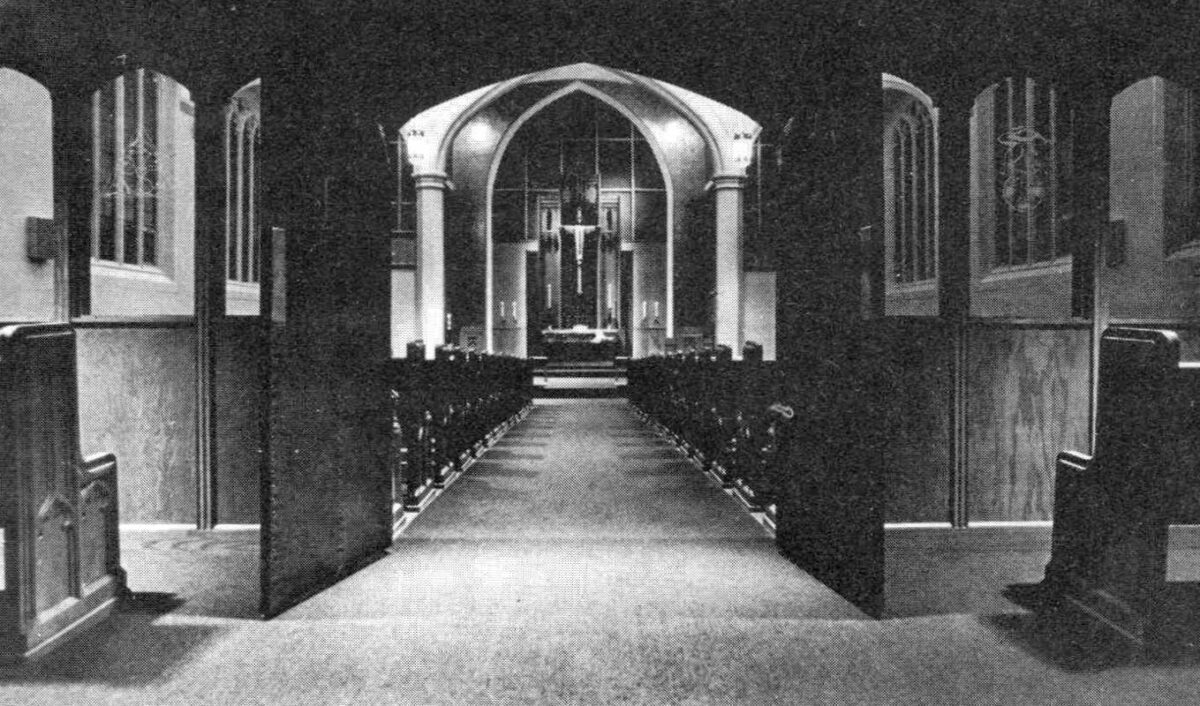
The new church interior, 1980.
An outreach program was developed in partnership with two churches in Chicago. Our big yellow bus, Sir Bethlehem, transported their members and ours to shared destinations. A contemporary worship service was introduced, along with the creation of a Christian contemporary rock group called the Daystar Band.
In 1995, Bethlehem installed air conditioning, much to everyone's delight.
In June 2001, renovations began in preparation for the church's 90th anniversary. These updates resulted in the church we see today. The building was made handicap-accessible with the installation of an elevator. A new entryway and connecting stairways created a seamless flow between the church and the education building.
On February 15, 2003, the Congregational Church offered Bethlehem the first right of purchase for their adjacent property. Bethlehem accepted, acquiring their church building, parking lot, and parsonage. This acquisition provided much-needed parking space and allowed Bethlehem to lease part of the property for a Lutheran Home adult day care center, later named Cherished Place.
Bethlehem took possession of the Congregational property and renamed it the Bethlehem Community Ministry Center (BCMC). While the Congregational Church retained their stained-glass windows, Bethlehem replaced them with clear, double-paned windows that brought natural light into the sanctuary. Volunteers from Bethlehem undertook significant renovations, including demolition, digging a water main trench, installing a handicap-accessible bathroom, and adding a shower, laundry facilities, kitchen upgrades, windows, painting, staining, ceiling tiles, and electrical and plumbing updates to meet code requirements. The renovations were completed by December 2007, and on January 1, 2008, Cherished Place officially opened in its new space.
Bethlehem celebrated its 100th anniversary in 2009 with a special event held each month throughout the year. Former pastors, interim pastors, members who had gone on to become pastors, important Synod representatives, and the congregation's oldest and youngest members were among the honored guests.
The Congregational parsonage was briefly home to the Children’s House Montessori School and is currently leased to "My Secret Garden," which hosts children’s tea parties and dress-up events.
In 2017, a beautiful new sign was installed in front of the red-brick church—the very sign you see at the top of this page.
Bethlehem also adopted a new mission: "To share the Living Water of Jesus Christ with all who thirst." A complementary logo was designed to reinforce this mission. The Contemporary Worship service was renamed "The Well" to align with this vision.
The sanctuary underwent a full renovation, including new carpeting, updated wall coverings, replacing pews with comfortable chairs, and upgrading the elevator.
The Messengers Praise Band and Singers now lead worship with Contemporary Christian Music. Audio-visual technology enhances the worship experience by projecting song lyrics for congregational singing, supporting sermons with visuals and videos, and sharing informational messages and announcements.
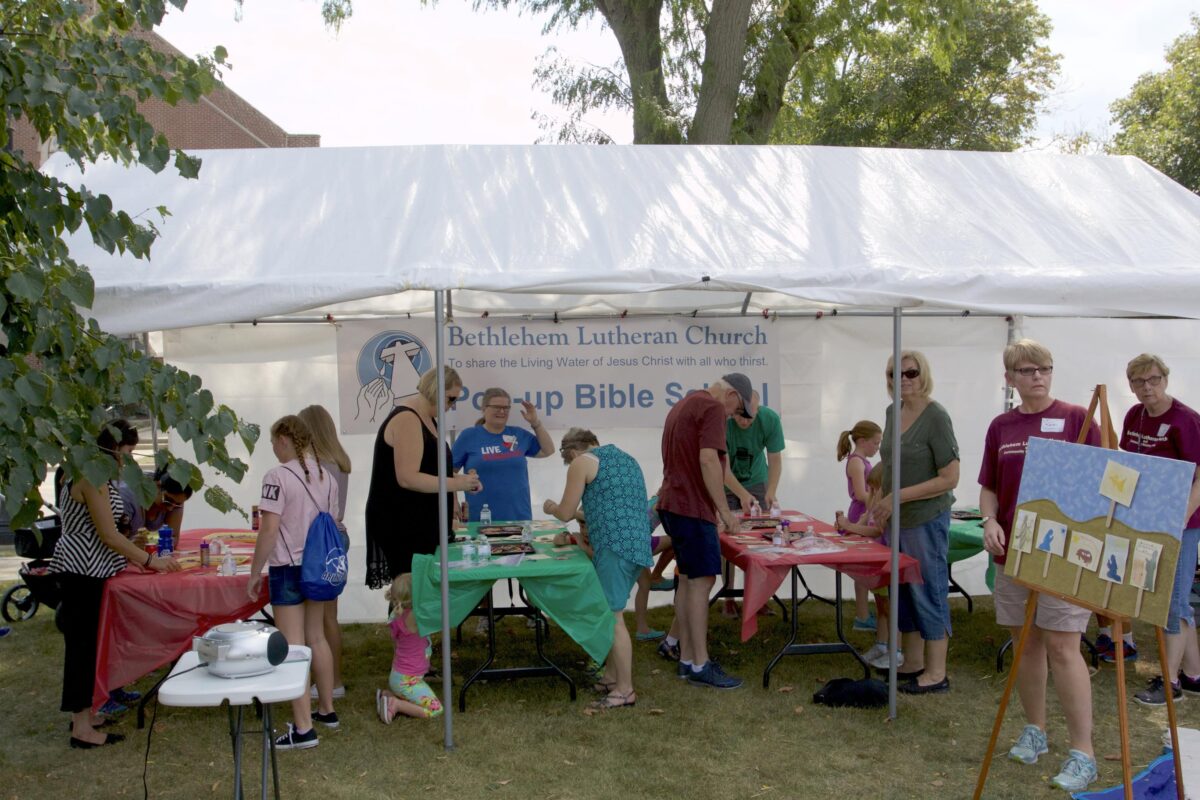
For several years, Bethlehem hosted a pop-up Bible school at Graffelman Park during West Dundee’s annual Heritage Fest celebration. Live playlets depicting the birth of Christ were performed, and craft activities were provided for children.
In 1995, Bethlehem installed air conditioning, much to everyone's delight.
In June 2001, renovations began in preparation for the church's 90th anniversary. These updates resulted in the church we see today. The building was made handicap-accessible with the installation of an elevator. A new entryway and connecting stairways created a seamless flow between the church and the education building.
On February 15, 2003, the Congregational Church offered Bethlehem the first right of purchase for their adjacent property. Bethlehem accepted, acquiring their church building, parking lot, and parsonage. This acquisition provided much-needed parking space and allowed Bethlehem to lease part of the property for a Lutheran Home adult day care center, later named Cherished Place.
Bethlehem took possession of the Congregational property and renamed it the Bethlehem Community Ministry Center (BCMC). While the Congregational Church retained their stained-glass windows, Bethlehem replaced them with clear, double-paned windows that brought natural light into the sanctuary. Volunteers from Bethlehem undertook significant renovations, including demolition, digging a water main trench, installing a handicap-accessible bathroom, and adding a shower, laundry facilities, kitchen upgrades, windows, painting, staining, ceiling tiles, and electrical and plumbing updates to meet code requirements. The renovations were completed by December 2007, and on January 1, 2008, Cherished Place officially opened in its new space.
Bethlehem celebrated its 100th anniversary in 2009 with a special event held each month throughout the year. Former pastors, interim pastors, members who had gone on to become pastors, important Synod representatives, and the congregation's oldest and youngest members were among the honored guests.
The Congregational parsonage was briefly home to the Children’s House Montessori School and is currently leased to "My Secret Garden," which hosts children’s tea parties and dress-up events.
In 2017, a beautiful new sign was installed in front of the red-brick church—the very sign you see at the top of this page.
Bethlehem also adopted a new mission: "To share the Living Water of Jesus Christ with all who thirst." A complementary logo was designed to reinforce this mission. The Contemporary Worship service was renamed "The Well" to align with this vision.
The sanctuary underwent a full renovation, including new carpeting, updated wall coverings, replacing pews with comfortable chairs, and upgrading the elevator.
The Messengers Praise Band and Singers now lead worship with Contemporary Christian Music. Audio-visual technology enhances the worship experience by projecting song lyrics for congregational singing, supporting sermons with visuals and videos, and sharing informational messages and announcements.
For several years, Bethlehem hosted a pop-up Bible school at Graffelman Park during West Dundee’s annual Heritage Fest celebration. Live playlets depicting the birth of Christ were performed, and craft activities were provided for children.
Bethlehem's 90th Anniversary and Beyond
As part of another community outreach program, just before the school year began, Bethlehem welcomed students from the community whose families may have struggled to afford school supplies. Students received free backpacks and school supplies and enjoyed ice cream and craft projects.